
Aristotle's Tyrant Playbook: Why Rhetoric + Action = Compliance
Aristotle's survival advice to tyrants applies directly to change management: the best way to persuade your team you're acting in their interest is to actually do it—but your rhetoric must match your deed. A dean who cuts programs while pledging 'the moment we find funds, we will restore them' earns compliance; a dean who simply mandates cuts provokes resistance. The Byzantine Empire held together for centuries because rulers paired this alignment of word and deed with a unifying identity against external threats.
“We see this pattern constantly in change rollouts: identical process changes succeed or fail based on whether leadership communicates solidarity ('I'm in this with you') and a credible restoration path. Organizations that skip the rhetoric phase see 2-3x higher resistance rates and longer adoption timelines.”
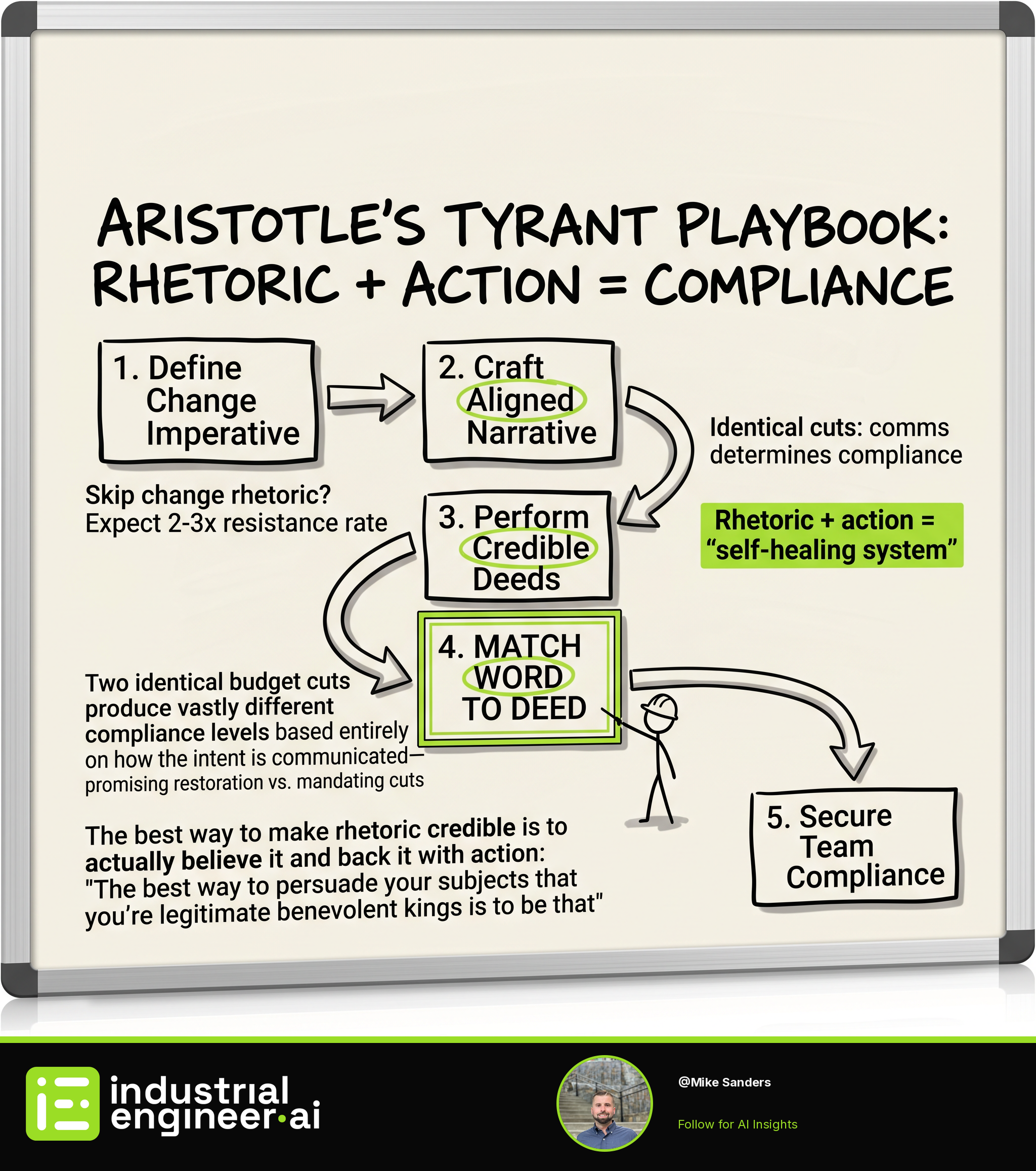
Aristotle's survival advice to tyrants applies directly to change management: the best way to persuade your team you're acting in their interest is to actually do it—but your rhetoric must match your deed. A dean who cuts programs while pledging 'the moment we find funds, we will restore them' earns compliance; a dean who simply mandates cuts provokes resistance. The Byzantine Empire held together for centuries because rulers paired this alignment of word and deed with a unifying identity against external threats.
From the Source
"Those two just rhetorical strategies, they're aiming at the same practical outcome, will produce very different levels of compliance, right? And consensus."
— Why the Roman Empire lasted so long | Anthony Kaldellis and Lex Fridman
Key Takeaways
- 01Two identical budget cuts produce vastly different compliance levels based entirely on how the intent is communicated—promising restoration vs. mandating cuts
- 02The best way to make rhetoric credible is to actually believe it and back it with action: 'The best way to persuade your subjects that you're legitimate benevolent kings is to be that'
- 03The Byzantine Empire's 1,000-year stability came from two factors: authorities genuinely working for subjects' interests AND a unified Roman/Orthodox identity against external enemies
- 04Aristotle's advice to tyrants was essentially 'become a benevolent king'—obey laws, work for subjects' interests—because tyrants who don't are killed in coups
- 05Rhetoric alone fails; action alone is insufficient. The combination creates the 'self-healing system' that allows organizations to survive internal conflicts and civil wars
Watch the Source
Why the Roman Empire lasted so long | Anthony Kaldellis and Lex Fridman
Source
Why the Roman Empire lasted so long | Anthony Kaldellis and Lex Fridman
Video embedded above — watch without leaving the site
Extracted and verified via Adversarial AI Pipeline
// RELATED SOLUTIONS
Get the IE.AI Weekly Brief
Top 3 AI-distilled industrial engineering insights, every Sunday. No fluff.
No spam. Unsubscribe anytime with one click.