
Why Robots Aren't Enough: Bridging the Automation Gap in Fulfillment Centers
“We see idle time as the silent margin killer in every AMR deployment — even a 10% reduction in task-transition lag across a fleet of 50 robots can recover the equivalent of 5+ full robot-shifts per day, which at $15-$25/hr equivalent robot cost translates directly to six figures annually.”
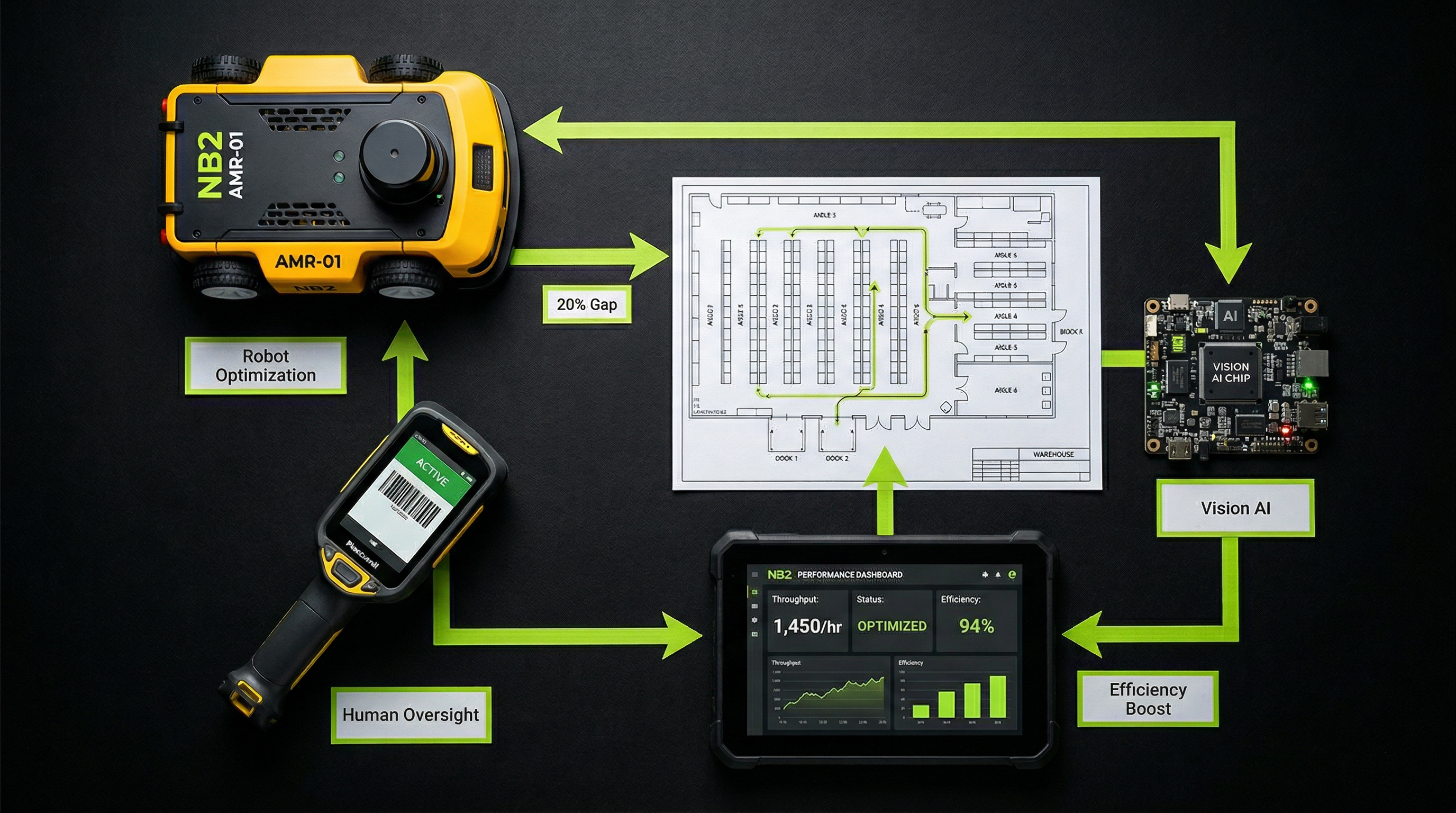
AMR idle time — the dead minutes between picks, putaways, and task queues — is one of the largest hidden throughput killers in fulfillment centers, often consuming 15-30% of a robot's shift. Zebra Technologies' new fulfillment robot is built specifically to compress those task-to-task transitions, targeting the gap that most AMR vendors ignore once the unit is 'deployed.' The question isn't whether idle time matters — it's whether Zebra can prove the reduction with hard numbers against competitors like Locus and 6 River.
From the Source
"The focus of the system is to reduce the idle time that many other AMR solutions experience."
— Demoing Zebra Technologies New Robot
Key Takeaways
- 01AMR idle time between tasks can consume 15-30% of operational hours (industry benchmark: MHI / Interact Analysis)
- 02Zebra's new robot is purpose-built for fulfillment center task-transition speed
- 03Idle time reduction directly maps to throughput per labor hour — the metric that drives warehouse P&L
- 04No specific reduction benchmarks stated — performance claims remain unquantified at demo stage
- 05Competitive gap: Locus, 6 River, and Geek+ all face the same idle-time problem but rarely publish transition-time data
Watch the Source
Demoing Zebra Technologies New Robot
Source
Demoing Zebra Technologies New Robot
Video embedded above — watch without leaving the site
Extracted and verified via Adversarial AI Pipeline
Get the IE.AI Weekly Brief
Top 3 AI-distilled industrial engineering insights, every Sunday. No fluff.
No spam. Unsubscribe anytime with one click.