
IPO Readiness Isn't Just About Finances—It's About Operational Scaling
“We see the same pattern in manufacturing and logistics: companies chase a big transformation (automation, AI, IPO) before fixing the fundamentals — and waste 15-25% of operational budget on initiatives that never deliver. Fix the process first, then scale.”
SVB data shows only 5% of unicorns meet the IPO bar ($300M+ ARR with Rule of 40+ performance), and the author suspects the real number is closer to 2.5%. For the other 95%, every dollar spent on IPO prep — $1,000/hour legal fees, board composition, SOX readiness — is operational waste that should be redirected toward fixing core financials or positioning for acquisition.
From the Source
"95% of unicorns are zombies...I think the real percentage we will see from this vintage is closer to half of that."
— What Does It Take to IPO?
Key Takeaways
- 01Only 5% of unicorns ($1B+ valuations) meet $300M ARR + Rule of 40+ — the minimum IPO bar (SVB data)
- 0250% of unicorns are growing revenue less than 20% annually
- 03Only 7 of 52 cloud IPOs since 2018 have beaten the QQQ ETF; average QQQ-adjusted return is -42%
- 04IPO preparation requires 18-24 months of lead time — mostly on finance and accounting teams
- 05Accounting is the #1 reason for delayed IPOs; premature prep wastes money and senior leadership bandwidth
Read the Source
# IPO Readiness in 2026: A CFO’s Guide
**Today’s Sponsor:** NetSuite
[

](https://6262239.extforms.netsuite.com/app/site/crm/externalleadpage.nl/compid.6262239/.f?formid=4352&h=AAFdikaIxHz0iGOfUVwBWvKQf4oZykH65yHelQGpZ4b5weNXsY4&redirect_count=1&did_javascript_redirect=T&leadsource=Email_Horiz_CFOAIFIN_OnlyCFO_0126)
Artificial intelligence technology is here, and finance leaders know it can help them make faster and more-informed decisions, says the CFO Alliance. Will you use it to enhance your financial leadership, improve operational efficiency, and drive a competitive advantage?
[Download the guide](https://6262239.extforms.netsuite.com/app/site/crm/externalleadpage.nl/compid.6262239/.f?formid=4352&h=AAFdikaIxHz0iGOfUVwBWvKQf4oZykH65yHelQGpZ4b5weNXsY4&redirect_count=1&did_javascript_redirect=T&leadsource=Email_Horiz_CFOAIFIN_OnlyCFO_0126) to discover how NetSuite’s AI capabilities can empower your financial leadership and drive your organization’s success.
[CFO's Guide to AI-Enhanced Finance](https://6262239.extforms.netsuite.com/app/site/crm/externalleadpage.nl/compid.6262239/.f?formid=4352&h=AAFdikaIxHz0iGOfUVwBWvKQf4oZykH65yHelQGpZ4b5weNXsY4&redirect_count=1&did_javascript_redirect=T&leadsource=Email_Horiz_CFOAIFIN_OnlyCFO_0126)
> **We are ~2 years away from an IPO** — _every single VC-backed founder_
Back in the glory days of 2021, every company I talked to was ~2 years away from an IPO (according to their founder). Even the companies with ~$15M of revenue and no real finance team would talk like an IPO was just around the corner.
Just a couple of those have actually IPOed since then…
While a bit more realistic today, I talk to many CEOs who are still delusional about their IPO prospects.
I don’t want to be a dream crusher, but…I do want folks to face reality. Chasing an IPO that will never happen isn’t good for anyone (other than your $1,000/hour external legal folks that round up every 15 minute phone call to one hour). And if you are actually on the IPO path, then I want to make sure you are properly preparing.
[Share](https://www.onlycfo.io/p/what-does-it-take-to-ipo?utm_source=substack&utm_medium=email&utm_content=share&action=share)
There are two key things to being IPO-ready:
1. Financial and metric readiness (_is the company good enough?_)
2. IPO/Public company readiness (_is the finance and other back office stuff ready?)_
99% of being IPO-ready is #1. Nothing else matters if you don’t have a successful company with a compelling story for investors.
But that last 1% of IPO preparation (#2 above) can take a surprisingly long time and delay an otherwise IPO-ready company. The bulk of this post focuses on the prep required by the finance/accounting teams.
> **Are you worthy of being a public company?**
I will write another post at some point on my thoughts here since there is so much to cover. But there is one point I want to make. Most of you are not worthy of the public markets…Sorry, the truth hurts.
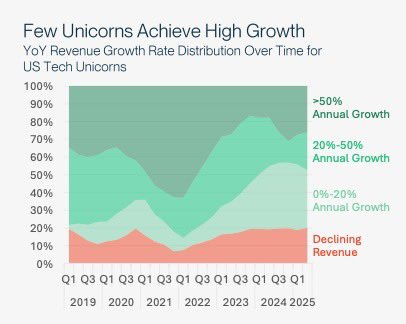
Below is some data on unicorns ($1B+ valuations) from SVB:
* 50% of unicorns are growing revenue less than 20% annually.
* Only 5% of all unicorns are >$300M ARR (probably min bar to go public) and also have a Rule of 40+ score
**So 95% of unicorns are zombies?** uh oh…that’s a lot of zombies. And I would be very surprised if 5% is really able to IPO. I think the real percentage we will see from this vintage is closer to half of that.
[
](https://substackcdn.com/image/fetch/$s_!cXOa!,f_auto,q_auto:good,fl_progressive:steep/https%3A%2F%2Fsubstack-post-media.s3.amazonaws.com%2Fpublic%2Fimages%2F04dda40d-ee31-4c2f-bcef-3adb0ae132c9_406x324.jpeg)
source: SVB
Historically, when a unicorn was born, there was a real expectation that they could IPO. Or, in a more worst-case scenario, be acquired by private equity. Well...it seems ~95%+ are not IPO worthy. And based on conversations with several PE folks, they also don’t want to touch a significant amount of that 95% (at least anywhere near the valuation expectations they currently have).
I am being a bit of a dream crusher so companies that are not on the IPO path don’t waste precious money and time on an IPO that isn’t coming. A glorious amount of money/time can be wasted here…
If you are not IPO worthy, then your team should be focusing on:
1. Can you turn things around to become IPO worthy?
2. Are you an attractive acquisition target? If not, how do you become one?
3. Do you need to get to FCF positive so you have more time to figure things out?
One reason that typical cloud companies will continue to struggle to IPO is the dismal performance of the cloud sector and their recent IPOs.
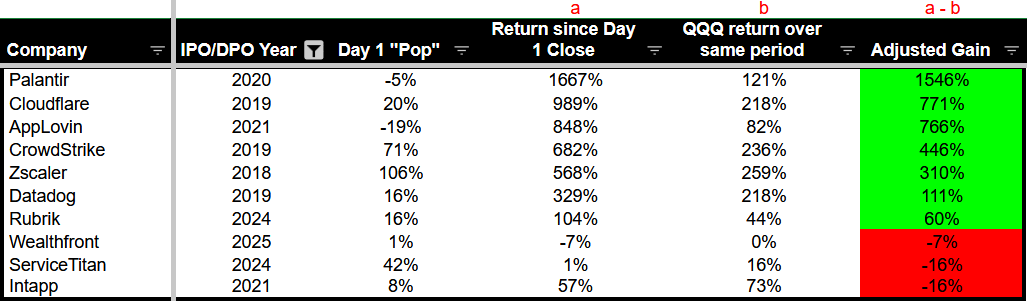
Only 7 cloud companies that have IPOed since 2018 (of the 52 that I am tracking) have beaten the QQQ ETF over the same time period since they went public.
Just 7 companies…
[
](https://substackcdn.com/image/fetch/$s_!vcsz!,f_auto,q_auto:good,fl_progressive:steep/https%3A%2F%2Fsubstack-post-media.s3.amazonaws.com%2Fpublic%2Fimages%2F562cef4d-010d-4eb3-97ba-bfa13e512212_1027x301.png)
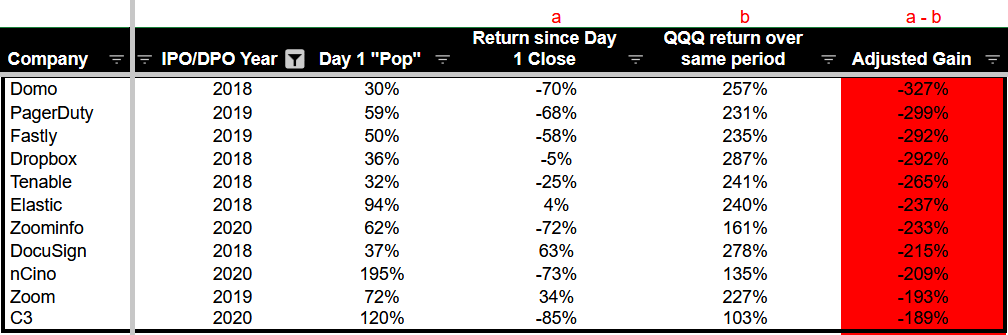
And look at the bottom 10 companies on this list…ouch.
[
](https://substackcdn.com/image/fetch/$s_!x_Ai!,f_auto,q_auto:good,fl_progressive:steep/https%3A%2F%2Fsubstack-post-media.s3.amazonaws.com%2Fpublic%2Fimages%2F4ed056fa-26b0-467b-995c-b9f10cf35f8d_1008x335.png)
The average QQQ adjusted return of all these cloud IPOs since their Day 1 IPO close is -42% 🤮. When returns are that bad, public market investors are going to be very cautious with similar IPOs.
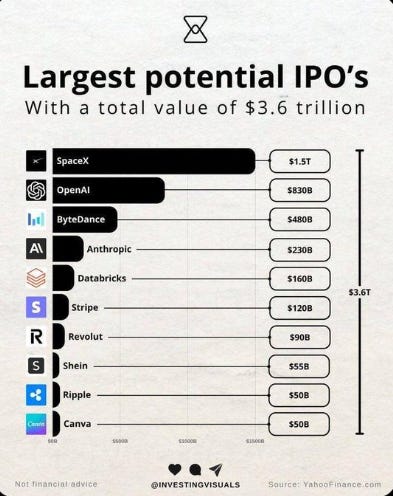
2026 might be a blockbuster year for IPOs, but it will be because a handful of massive companies with fantastic metrics and story go public. The below shows the largest potential 2026 IPO candidates. These companies will drive most of the excitement and IPO volume.
[
](https://substackcdn.com/image/fetch/$s_!jGbP!,f_auto,q_auto:good,fl_progressive:steep/https%3A%2F%2Fsubstack-post-media.s3.amazonaws.com%2Fpublic%2Fimages%2F36f55209-f9bb-4c6b-9a0a-c33d73612747_393x496.png)
I hope there are smaller scale IPOs, but you need to know it’s tough right now unless your metrics are excellent.
Great, you made it to step #2! You’ve got a business worthy of being public. The REALLY hard part is done!
But getting actually ready to be a public company can take a surprisingly long time and require a lot of hard work, particularly from finance and accounting.
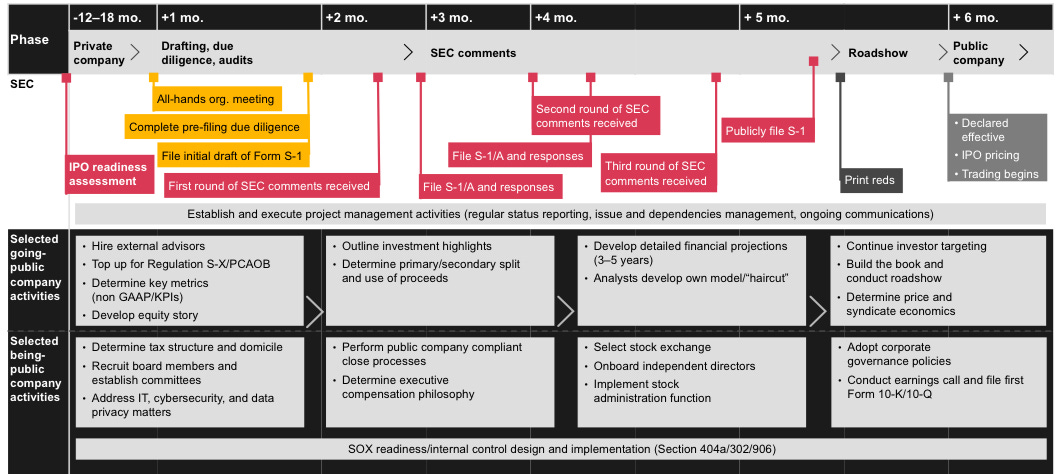
Below is a timeline and milestone summary for an IPO. If you take nothing else away from this post, remember that **IPO planning should start 18 to 24 months before the actual IPO.**
It can be done in a shorter timeline…but it will be HARD!
[
](https://substackcdn.com/image/fetch/$s_!3wIL!,f_auto,q_auto:good,fl_progressive:steep/https%3A%2F%2Fsubstack-post-media.s3.amazonaws.com%2Fpublic%2Fimages%2F9452b89b-902b-4b32-ae43-6f0f8c38f081_1061x474.jpeg)
source: PwC
There is a lot for a CFO to consider when getting a company IPO-ready. Below are the key things that you need to get right (and in most cases, do many quarters before the actual IPO).
The management team is the most important thing in preparing for an IPO and being a public company. And you need a lot of them well in advance of an IPO so they can put new processes, systems, etc in place before an IPO.
Lots of companies start thinking about this way too late…
* Determine early if your board composition will satisfy SEC and listing exchange requirements so you have time to make the necessary changes. Boards are required to have a majority of independent directors within one year of being public.
* Finding good independent board members can take time. Begin early so you can find the right people.
* Set up the required board committees. The first two committees below are frequently established earlier while the third is often set up shortly before an IPO.
* Audit committee
* Compensation committee
* Nominating & corporate governance committee
Most of the responsibility for IPO preparation is on the CFO’s team.
Having the right CFO with IPO and/or public company experience will make things way easier and smoother. It can be OK for the CFO to not have IPO experience (many have done it) but they need to rely heavily on their network and advisors for help through the process.
Below are a few of the important resources that companies need to think about:
* **Technical Accounting** - Should have someone internal but will likely also need outsourced technical folks. There is lots to do in an IPO process to make sure all complex accounting matters are handled properly
* **Controller** - Someone that knows what it takes to be a public company (strong Big 4 experience, public company experience, etc). Please make sure you have a strong Controller!
* **Financial Reporting** - Often not hired until IPO preparation begins but large private companies might need someone earlier. You will likely also need external help as well.
* **Tax Specialist** - Becoming a public company can have huge tax implications and a tax expert should be brought on early in the process to help with optimal legal tax structures, internal controls, tax positions, etc.
* **Internal Audit** - Maintaining a proper internal control environment is critical, especially as a company prepares to be compliant with Sarbanes-Oxley Act (known as “SOX”)
* **Investor Relations** - Often hired during some point of the IPO preparation process.
* Are there any other areas of the management team that need to be built out?
* Do any current leaders need to be “topped” (i.e. add someone above them) with the right experience?
There are a lot of external experts and advisors you need during the IPO process.
* **Underwriters -** These are the folks that run the show and should be found early in the process as they will help guide everything else.
* **IPO legal counsel** \- You need strong legal counsel (both internal and external) with public company experience.
* **Capital markets advisors**
* **Auditors** - You may need to upgrade to bigger firm if you aren’t using Big 4. Also, ensure you have proper independence with the audit firm.
* **Accounting Advisors** - Your internal team still has their day jobs to do so the accounting advisors will help with additional technical accounting documentation, drafting financials needed for an IPO, etc.
* **Risk Advisors** - help support and enable companies to become SOX compliant
Accounting is the #1 reason for delayed IPOs. A
Source
What Does It Take to IPO?
Article reader embedded above — read without leaving the site
Extracted and verified via Adversarial AI Pipeline
Get the IE.AI Weekly Brief
Top 3 AI-distilled industrial engineering insights, every Sunday. No fluff.
No spam. Unsubscribe anytime with one click.