
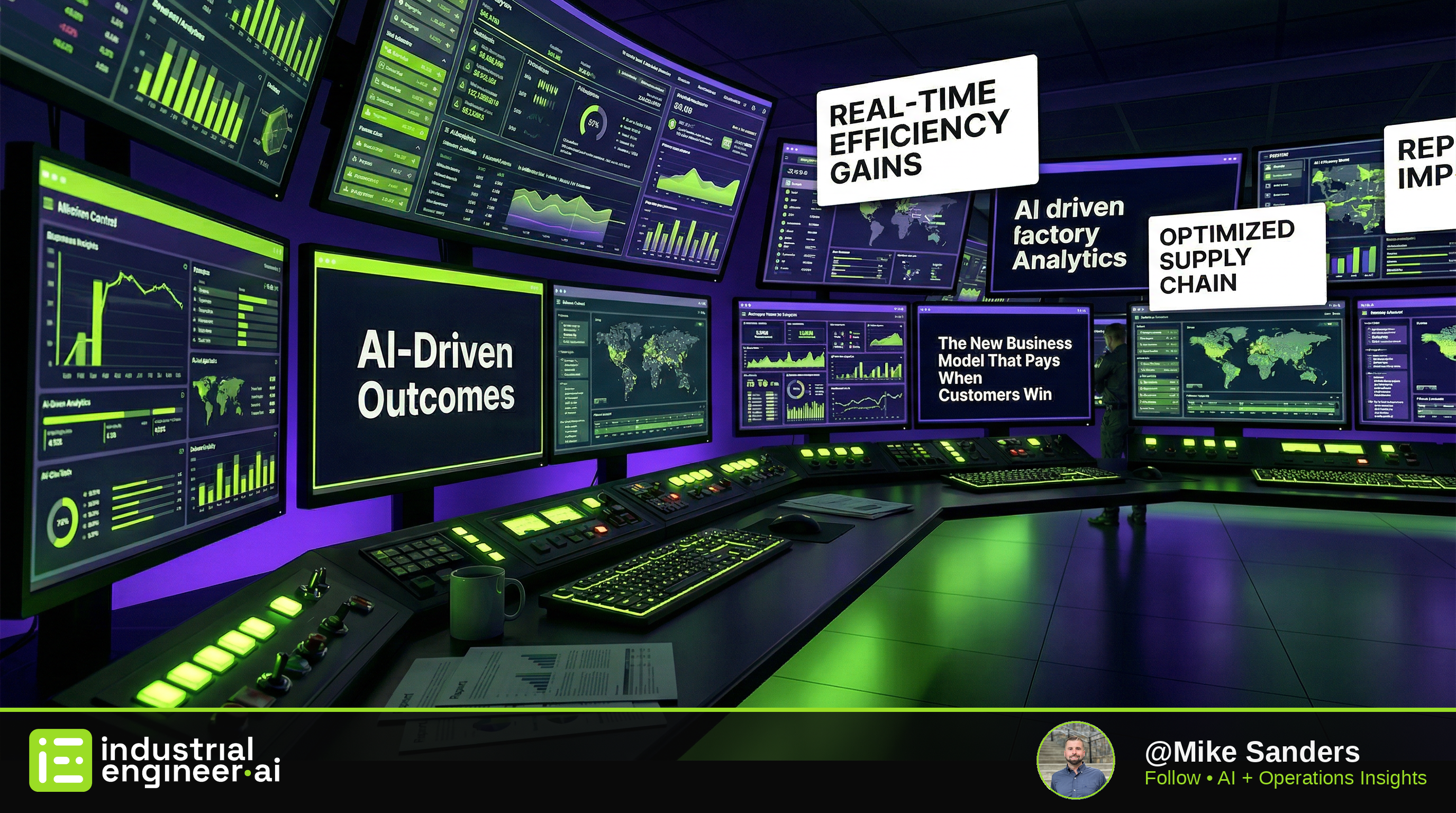
AI-Driven Outcomes: The New Business Model That Pays When Customers Win
“We see this as a fundamental process redesign challenge: if you're only paid on customer outcomes, your operations need closed-loop feedback systems that measure downstream impact, not just upstream throughput — and industry data shows outcome-aligned contracts can improve customer retention by 15-25% while reducing churn-related revenue loss.”
Pay-for-performance models — where suppliers only get paid when customers achieve measurable results — can actually reduce supplier risk by aligning incentives with customer success, not just delivery. Pine argues the real shift is that customers don't want better products or experiences; they want to become better themselves, and AI-enabled mass personalization is what makes it operationally feasible to guide each customer toward individual transformation at scale.
From the Source
"It's not enough to acquire and retain customers... companies must deliver outcomes and might only get paid when customers succeed."
— What You Must Deliver to Win Customers Today
Key Takeaways
- 01Customers want personal transformation, not just better products — 'a way for themselves to become better' (Pine's core thesis)
- 02Pay-for-performance shifts revenue risk but aligns supplier operations with outcomes that drive retention and lifetime value
- 03AI and mass personalization make it operationally viable to deliver individualized outcomes instead of one-size-fits-all services
- 04Operations must redesign around customer-specific success metrics, not internal output metrics like units shipped or tickets closed
- 05This model applies across industries — healthcare (patient outcomes), logistics (delivery guarantees), manufacturing (yield commitments)
Read the Source
# What You Must Deliver to Win Customers Today
* Details
* Transcript
February 13, 2026
What if your customers aren’t looking for better products and services, but for a way for _themselves_ to become better? While the experience economy remains important, Strategic Horizons cofounder **B. Joseph Pine II** argues that it’s not enough to acquire and retain customers in today’s competitive environment. He sees the next wave in business as one focused on offering outcomes to customers – and that might even mean only getting paid when customers succeed. He shares how this model might actually reduce risk, what it means in a world of AI and mass personalization, and ways that companies can truly deliver on their promises. Pine is author of the book _[The Transformation Economy: Guiding Customers to Achieve Their Aspirations](https://www.amazon.com/Transformation-Economy-Guiding-Customers-Aspirations-ebook/dp/B0DRZ3TX54)._
* Subscribe On:
* [Apple](https://itunes.apple.com/us/podcast/hbr-ideacast/id152022135?mt=2 "Go to Apple Podcasts")
* [Spotify](https://open.spotify.com/show/4gtSBBxIAE142ApX6LqsvN "Go to Spotify Podcasts")
* [RSS](http://feeds.harvardbusiness.org/harvardbusiness/ideacast "View Podcast Series RSS Feed")
Episode 1068
### [The New Leadership Structures that Unblock Innovation](https://hbr.org/podcast/2026/03/the-new-leadership-structures-that-unblock-innovation "Go to Podcast")
The ability of an organization to innovate over and over again, for the long term, depends on leadership structure, culture, and systems. That's according to Harvard Business School professor Linda Hill, who has spent years researching the true drivers of innovation, taking lessons from the world's most successful companies. She explains why today's leaders need to shift from the focus on decision-making and producing to creating the conditions for collaboration, experimentation, and smart decision-making across teams, silos, and wider ecosystems. She shares examples from Mastercard, Pixar, and more and outlines some newly defined ways of looking at leadership roles: as Architects, Bridgers, and Catalysts. Hill's new book is Genius at Scale: How Great Leaders Drive Innovation.
Episode 1067
### [Assuming the Best About Others is Hard—But Necessary](https://hbr.org/podcast/2026/02/assuming-the-best-about-others-is-hard-but-necessary "Go to Podcast")
Are you guilty of bracing for the worst when it comes to your clients, colleagues, and bosses? Amer Kaissi, professor at Trinity University, explains why bringing that negative mindset to work will quietly undermine your team, organization, and career. He wants leaders to instead adopt a "positive intent mindset," which means giving everyone -- even people who disappoint you or with whom you vehemently disagree -- the benefit of the doubt. He shares five key capabilities we can all build to improve trust and performance without sacrificing accountability. Kaissi's book is called The Positive Intent Mindset: Exceptional Leadership Through Trust and Accountability.
Episode 1066
### [With Rise of Agents, We Are Entering the World of Identic AI](https://hbr.org/podcast/2026/02/with-rise-of-agents-we-are-entering-the-world-of-identic-ai "Go to Podcast")
What if the AI you integrate into your organization isn't just about efficiency or creating digital assistants, but completely changes how you work? Longtime digital trend watcher Don Tapscott says the next wave of artificial intelligence is all about identic AI - where personalized agents don't just complete tasks, but understand your judgment and values and take actions on your behalf. He explains the technologies for this that already exist amid the rise of agents and bots, what it means for leaders and organizations, and the pitfalls to look out for. Tapscott is author of You to the Power of Two: Redefining Human Potential in the Age of Identic AI.
Episode 1065
### [What You Must Deliver to Win Customers Today](https://hbr.org/podcast/2026/02/what-you-must-deliver-to-win-customers-today "Go to Podcast")
What if your customers aren't looking for better products and services, but for a way for themselves to become better? While the experience economy remains important, Strategic Horizons cofounder B. Joseph Pine II argues that it's not enough to acquire and retain customers in today's competitive environment. He sees the next wave in business as one focused on offering outcomes to customers - and that might even mean only getting paid when customers succeed. He shares how this model might actually reduce risk, what it means in a world of AI and mass personalization, and ways that companies can truly deliver on their promises. Pine is author of the book The Transformation Economy: Guiding Customers to Achieve Their Aspirations.
Episode 1064
### [The Cognitive Science Behind Sudden Change](https://hbr.org/podcast/2026/02/the-cognitive-science-behind-sudden-change "Go to Podcast")
Difficult change is an inevitable part of life, but few of us have the skills and mindset to handle it well. That can trickle into our work and careers, but there are lessons from psychology that can help us be more resilient. Dr. Maya Shankar, cognitive scientist and host of the podcast A Slight Change of Plans, shares concepts that can help you react, reframe, and adapt in life or work. She offers evidence-based strategies for leaders navigating personal, organizational, and technological upheaval—from burnout and culture shifts to AI-driven transformation. Shankar is author of the book The Other Side of Change: Who We Become When Life Makes Other Plans.
### Latest in this series
Source
What You Must Deliver to Win Customers Today
Article reader embedded above — read without leaving the site
Extracted and verified via Adversarial AI Pipeline
Get the IE.AI Weekly Brief
Top 3 AI-distilled industrial engineering insights, every Sunday. No fluff.
No spam. Unsubscribe anytime with one click.